
Snack time is a moment to refuel and recharge, boost concentration, build a positive relationship with food... and even plant seeds for the future.


Children spend a significant portion of their days in school. This environment is therefore fertile ground for encouraging the development of a healthy lifestyle in close collaboration with parents. But how does this look in practice? What if an everyday activity, like snack time, became a way to learn in a different way? A moment to refuel and recharge, boost concentration, build a positive relationship with food... and even plant seeds for the future.
The key role of snacks
Snacks support children’s development by helping to meet their nutritional needs as they grow. They help complement children’s food intake, which can vary from one meal to the next. For example, snack time is a perfect moment to offer fruits, vegetables and dairy products—food categories that are often under-consumed1.
Snacks also help satisfy the increased hunger associated with growth spurts and prevent energy slumps, allowing children to reach the next meal feeling more focused. In fact, when children eat less at lunch—whether due to a conflict, medication or simply a fluctuating appetite—snacks become a valuable tool for maintaining concentration in class2.

Open snack time – Finding balance between autonomy and structure
In some school settings, there is a trend toward an open snack time, where children can snack at a time of their choosing rather than setting aside a specific period for everyone to eat together. The intentions behind this approach are commendable: to foster autonomy and encourage children to listen to their hunger cues.
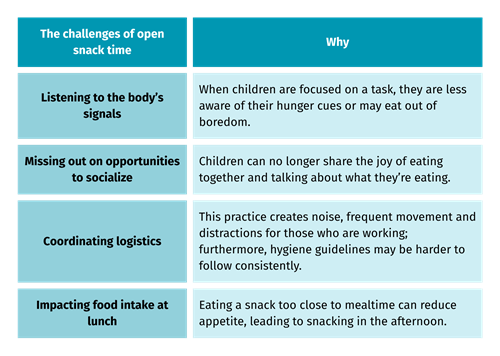
However, in practice, eating while working diminishes the quality of the eating experience, is at odds with established nutritional best practices3 and presents several challenges:
One of the approaches often emphasized when it comes to feeding children is the division of responsibility. With this approach, the adult decides when to eat. As for children, they decide whether to eat and how much to eat from the foods in their lunch boxes, depending on how hungry they are4. Consider offering a snack break about two hours before lunch. Children who are hungry will be able to eat, and for those who are not, lunch won’t be far off.
Taking a break together makes all the difference!
In addition to creating a pleasant moment of togetherness with friends, establishing a structured snack time can provide a break for both body and mind. In fact, a snack helps refuel and recharge, and improves concentration for learnings to come2.
Having a snack with your students also means being a positive role model: showing that you enjoy eating, that you take the time to savour your food and that you listen to your body’s hunger cues. It is also a chance for you to replenish your own energy stores.
Eating together encourages food curiosity: children observe, discuss and explore foods in a safe and fun environment. When paired with a supportive and positive attitude toward food, snack time becomes a powerful tool for building a healthy relationship with food. What the children eat becomes secondary; the primary goal is to help them listen to their body’s signals, socialize and enjoy eating together.
Who knows—once you’ve tried it a few times, this practice might quickly become a daily ritual that everyone enjoys!
Eating… and learning
What if snack time became a gateway to all sorts of discoveries? Without turning it into a formal lesson, snack time can serve as a great transition to learning. Simple conversations or observations, before or after eating, can spark the curiosity of children of all ages.
For younger children: naming the colour or shape of a food, counting the segments of a clementine or guessing where a food comes from. For older children: describing their snacks using sensory words, estimating the cost or considering the environmental impacts of packaging5. Even a brief discussion can encourage students to reflect and make connections between what they learn in school and their daily lives.
Research shows that it takes approximately 50 hours of positive exposure to food and eating to initiate a lasting change in lifestyle habits6. Ten minutes here and there, once or twice a week… and by the end of the year, you’ll have planted much more than just seeds in your students’ minds!
Looking for some inspiration?
Our team has developed a wide range of educational resources just for you! Our food-focused activities are simple, fun, free and easy to integrate into the school curriculum because they align with the Québec Education Program.
Browse our website and let us inspire you!
Everything you need to talk about food more often without adding to your workload!
Sowing today, reaping tomorrow
This shared moment over a snack may seem trivial, but it is far from it. It is an invitation to slow down, taste and listen—a positive habit that benefits students and adults alike!
Sharing a snack together is a meaningful way to help your students develop a positive relationship with food, providing them with a tool that will serve them well long after they leave your classroom.
Looking for nutritious snack suggestions to share with families? Order free copies of the Lunch Box and Snack Essentials brochure.
REFERENCES :
- Statistics Canada. (2015). Canadian Community Health Survey (CCHS). https://www.canada.ca/en/health-canada/services/food-nutrition/food-nutrition-surveillance/health-nutrition-surveys/canadian-community-health-survey-cchs/reference-guide-understanding-using-data-2015.html
- Martin, C. and Arcand, L. (2005). École en santé. Gouvernement du Québec. https://cdn-contenu.quebec.ca/cdn-contenu/education/soutien-eleves/Ecole-Sante-Guide-Milieu-Scolaire-Partenaires.pdf
- CIUSSS de la Capitale-Nationale. (n.d.). Document d’information pour l’équipe-école : la collation. Gouvernement du Québec. https://www.ciusss-capitalenationale.gouv.qc.ca/sites/d8/files/docs/SantePublique/VivreSante/ecole-sante/Document-information-equipe-ecole.pdf
- Ellyn Satter Institute. (2019). The division of responsibility in feeding. https://www.ellynsatterinstitute.org/the-division-of-responsibility-in-feeding
- Ministère de l’Éducation du Québec. (2006). Québec Education Program – Elementary Education. Gouvernement du Québec. https://www.quebec.ca/en/education/preschool-elementary-and-secondary-schools/programs-training-evaluation/quebec-education-program/elementary
- Briggs, M. et al. (2003). Position of the American Dietetic Association, Society for Nutrition Education, and American School Food Service Association—Nutrition services: an essential component of comprehensive school health programs. Journal of the American Dietetic Association, 103(4), 505-514. DOI: 10.1053/jada.2003.50100